
The dbt utils package stands as a cornerstone in the modern dbt ecosystem, offering a rich set of reusable macros and generic tests that streamline analytics engineering workflows. Developed by dbt Labs, it helps data teams avoid repetitive SQL patterns, improve code readability, and ensure cross-database compatibility. Whether handling time-series gaps, generating clean keys, or validating data quality, these utilities save hours of development time and reduce errors in production pipelines.
As dbt adoption grows across organizations, dbt utils remains one of the most installed community packages, appearing in countless projects from startups to enterprises. Its macros cover everything from simple conveniences to advanced dynamic logic, making complex transformations feel effortless. Understanding the most popular ones empowers teams to build scalable, maintainable data models faster.
In this comprehensive guide, we explore the most commonly used dbt-utils macros based on community patterns, documentation emphasis, and real-world adoption. These tools form the foundation of efficient dbt usage, turning raw data into reliable insights with minimal boilerplate.
dbt utils and Installation Basics
dbt utils provides ready-made solutions for common pain points in data modeling. Teams install it through a simple packages.yml entry and run dbt deps to bring it into the project. Once available, macros are invoked consistently with the dbt utils prefix.
Why dbt-utils Dominates Modern dbt Projects
The package addresses universal needs like time-series completeness and safe data handling. Its macros promote DRY principles, making models easier to read and refactor. Community feedback consistently highlights massive time savings in repetitive tasks.
Key Benefits for Analytics Engineers
These utilities handle edge cases automatically, such as NULL-safe operations or schema mismatches. They also support dynamic Jinja logic, allowing models to adapt based on data content without hardcoding.
Getting Started Quickly
Add the package with a pinned version range for stability. Always check compatibility with your dbt Core version before upgrading to avoid disruptions in existing workflows.
Core SQL Generation Macros for Everyday Modeling
SQL generators form the backbone of many dbt projects, automating verbose or tricky patterns that appear repeatedly across models.
date spine for Time-Series Completeness
This macro creates a continuous sequence of dates or timestamps between specified bounds. It excels at filling reporting gaps in sparse event data or building calendar dimensions for consistent analytics.
Teams use it daily in dashboards requiring zero-missing periods. Combine it with left joins to ensure every date appears, even without events.
Dynamic starts and ends pull from actual data minima and maxima, making spines adaptive to incoming feeds.
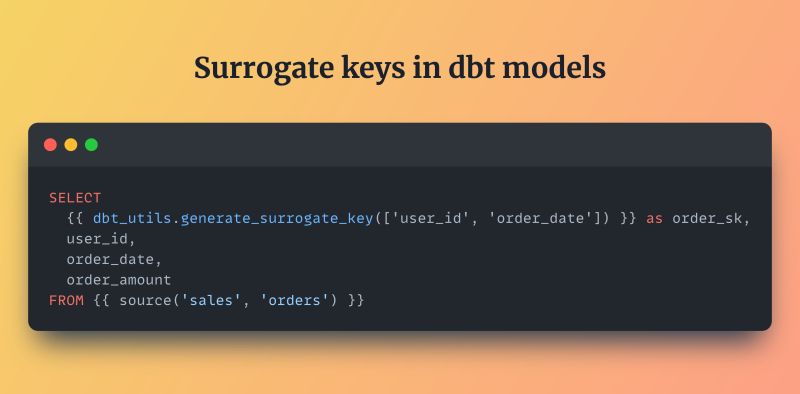
generate surrogate key for Deterministic Identifiers
Hashing multiple columns into a single surrogate key eliminates messy concatenation logic. It treats NULLs consistently and produces reliable joins across sources.
Staging layers rely on it heavily to standardize business keys lacking natural primaries. It supports composite keys effortlessly for dimensions with multiple attributes.
In large warehouses, this macro prevents key collision issues that plague manual hashing approaches.
star for Safe and Flexible Column Selection
Selecting nearly all columns while excluding a few prevents SELECT * pitfalls in production. Prefixes, suffixes, and aliases handle self-joins or CTE renames cleanly.
Refactoring wide tables becomes trivial with this utility. Incremental models benefit from excluding audit fields automatically.
Variants allow precise control over quoting and aliasing for complex queries.
Advanced Data Shaping and Transformation Utilities
These macros reshape data structures or handle unions and deduplication with elegance.
union_relations for Multi-Source Stacking
Combining similar tables from different periods or regions requires careful column alignment. This macro infers schemas, casts types, and fills missing columns with NULLs.
Global companies union country-specific feeds seamlessly. Adding a source indicator column tracks data provenance easily.
It simplifies partitioned ingestion patterns without manual UNION ALL boilerplate.
pivot and unpivot for Flexible Table Formats
Pivoting turns row values into columns for wide reporting views preferred by BI tools. Unpivoting normalizes wide legacy exports back to long format.
Dynamic value lists from get column values make pivots metadata-driven. Aggregation options like sum or count handle metrics naturally.
These macros bridge raw storage shapes and analysis-ready structures efficiently.
deduplicate for Cleaning Raw Inputs
Window-based deduplication removes duplicates based on partitions and ordering. It handles CDC streams or duplicate-prone APIs gracefully.
Qualify clauses adapt to warehouse syntax automatically. Tie-breakers ensure the freshest record survives.
Raw-to-staging layers depend on this to deliver clean intermediates reliably.
- date_spine ensures no date gaps in metrics
- generate_surrogate_key standardizes identifiers
- star avoids dangerous SELECT *
- union_relations merges heterogeneous sources
- pivot reshapes for reporting needs
- deduplicate enforces uniqueness early
Introspective Macros Enabling Dynamic Logic
Introspective macros query metadata at runtime, feeding results back into Jinja for adaptive code generation.
get_column_values for Metadata-Driven Transformations
Fetching distinct values from a column powers dynamic CASE statements or pivots. It supports defaults, ordering, and limits for control.
Payment method breakdowns become fully automatic. Filters exclude outliers or focus on active categories.
This macro unlocks configuration-as-code patterns in models.
get_relations_by_pattern for Schema Discovery
Pattern matching finds tables across schemas for bulk operations. It replaces older prefix-based approaches with greater flexibility.
Wildcard unions or automated documentation benefit enormously. It aids in large, evolving warehouses.
Use it cautiously to avoid performance hits on massive catalogs.
get_single_value and Related Helpers
Executing simple queries returns scalars or dicts for use in logic. It simplifies dynamic date bounds or config lookups.
Min/max extractions feed directly into spines or filters. Error handling ensures graceful fallbacks.
These helpers make models smarter without extra CTEs.
Essential Generic Tests for Data Quality Assurance
Generic tests in dbt-utils extend core dbt testing with parameterized, reusable checks applied in schema.yml files.
equality for Model Comparison and Migration
Row-by-row or aggregate comparisons validate refactored models against legacy versions. Column subsets focus tests efficiently.
Migration projects rely on it to catch regressions early. Fail calculations customize error reporting.
It builds confidence during major refactors or warehouse switches.
recency for Freshness Monitoring
Checking the maximum timestamp against thresholds ensures pipelines deliver timely data. Alerts trigger on staleness.
Operational dashboards monitor SLA compliance this way. Empty table handling avoids false positives.
Combine with scheduling for proactive observability.
not_null_proportion and Unique Combinations
Proportion tests verify completeness thresholds on key fields. Unique combinations enforce business rules on multi-column keys.
These catch subtle integrity issues missed by basic uniqueness tests. Thresholds allow gradual enforcement.
They integrate seamlessly into CI/CD gates.
- equality compares full relations reliably
- recency enforces data timeliness
- not_null_proportion checks field completeness
- unique_combination_of_columns validates keys
- accepted_range bounds numeric values
- relationships_where filters relational tests
Additional Utility Macros Worth Knowing
Beyond the heroes, several smaller macros solve niche but frequent problems effectively.
safe_divide and Arithmetic Helpers
Preventing division-by-zero or NULL propagation keeps calculations robust. Cross-database consistency avoids surprises.
Financial KPIs or ratios depend on safe versions. Zero defaults maintain meaningful outputs.
They replace verbose CASE logic everywhere.
group_by for Aggregation Shorthand
Writing GROUP BY 1,2,3 becomes unnecessary with positional references. It speeds prototyping significantly.
Aggregation models stay concise during exploration. Refactoring preserves intent clearly.
Small but addictive convenience in daily work.
slugify for Clean String Handling
Converting strings to URL-safe slugs aids in ID generation or labeling. It normalizes text consistently.
Dynamic column aliases become readable automatically. Debugging improves with human-friendly names.
Useful in reporting and API-facing layers.
In practice, dbt-utils evolves with the ecosystem some cross-database utilities have migrated to dbt Core adapters over time, but core generators and tests retain their central role. Teams often combine these with dbt-expectations for deeper statistical validation or elementary for observability alerts. Overriding via dispatch lets you customize behavior for specific warehouses without forking the package. Documenting macro usage in a shared style guide ensures consistency as projects scale. Experimenting with these in small models builds familiarity quickly, revealing how they compound to transform chaotic SQL into elegant, reusable patterns.
Conclusion
The most commonly used dbt-utils macros date_spine, generate_surrogate_key, star, union_relations, get_column_values, pivot, deduplicate, equality, and recency cover the majority of daily needs in analytics engineering. Incorporating them reduces code volume, enhances reliability, and accelerates delivery. Start small by adding a few to your next model, and watch productivity rise as patterns become second nature across your project. With dbt-utils, complex transformations turn simple, letting teams focus on insights rather than syntax.