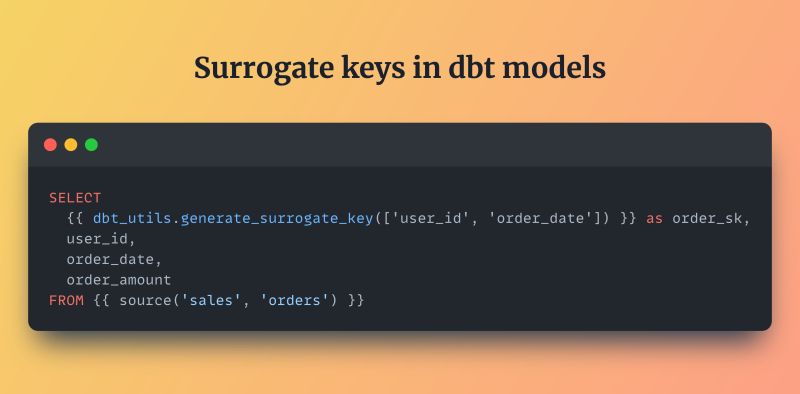

Data modeling in dbt relies heavily on unique identifiers to ensure accuracy and consistency. The surrogate_key macro from dbt utils is a powerful tool that generates stable, hash-based keys for your data. By combining multiple columns into a single identifier, it eliminates duplicates and simplifies joins. Understanding how this macro works can significantly improve your pipeline efficiency and data integrity.
The macro is particularly useful when working with slow-changing dimensions or composite keys. Instead of relying on natural keys, which may change over time, surrogate_key creates a consistent, deterministic identifier. This ensures that your transformations remain robust even as source data evolves. Let’s explore its functionality, use cases, and best practices in detail.
What is the surrogate_key macro?
The surrogate_key macro is a dbt utility that generates a unique identifier by hashing one or more columns. It’s designed to replace or supplement natural keys with a stable, immutable alternative. This is especially helpful when dealing with datasets lacking reliable primary keys or when combining multiple fields into a single identifier.
- Generates a SHA-256 hash by default
- Supports multiple input columns
- Ensures deterministic output for consistent results
By leveraging hashing, the macro produces a fixed-length string that uniquely identifies each row. This approach minimizes storage overhead while maintaining uniqueness. It’s a go-to solution for creating surrogate keys in dbt models, ensuring scalability and reliability.
How does hashing work?
Hashing transforms input data into a fixed-size string of characters. The surrogate_key macro uses this technique to create a reproducible identifier. Even small changes in input values result in a completely different hash, making it ideal for detecting duplicates or modifications.
The macro defaults to SHA-256, a secure and widely used hashing algorithm. This ensures that the generated keys are collision-resistant, meaning the likelihood of two different inputs producing the same hash is negligible. As a result, your data remains accurate and consistent across transformations.
Why use surrogate keys instead of natural keys?
Natural keys, such as emails or IDs, can change over time, leading to data integrity issues. Surrogate keys, generated by the macro, provide a stable alternative. They remain constant even if the underlying data changes, ensuring joins and lookups stay accurate.
- Natural keys may not always be unique
- Surrogate keys are immutable and reliable
- Simplifies handling slowly changing dimensions
By adopting surrogate keys, you future-proof your models against unexpected changes in source data. This approach is particularly valuable in enterprise environments where data consistency is critical.
Common use cases for surrogate_key
The surrogate_key macro shines in scenarios where natural keys are unreliable or missing. For example, in e-commerce datasets, combining user ID and transaction ID can create a unique order identifier. Similarly, in healthcare data, merging patient demographics with visit details ensures precise tracking.
Another use case is deduplication. By hashing relevant columns, you can easily identify and eliminate duplicate records. This is especially useful when merging data from multiple sources, where overlaps are common. The macro’s flexibility makes it adaptable to various industries and data challenges.
How to implement the surrogate_key macro
Implementing the surrogate_key macro in your dbt project is straightforward. Start by adding the macro to your model configuration, specifying the columns you want to include in the hash. The macro will then generate the surrogate key for each row, ensuring consistency across runs.
- Install dbt utils if not already present
- Reference the macro in your model
- Pass the desired columns as arguments
For example, in a SQL model, you can use {{ dbt_utils.surrogate_key(['column_a', 'column_b']) }} to create a key based on two fields. This simple integration makes it easy to adopt without extensive code changes.
Configuring the macro for your needs
The surrogate_key macro allows customization to fit your specific requirements. You can choose different hashing algorithms or adjust the output format. While SHA-256 is the default, other options like MD5 or SHA-1 are also supported, though they may offer less security.
Ensure that the input columns are clean and consistent. Null values or inconsistent formats can lead to unexpected results. Preprocessing your data before applying the macro guarantees accurate and reliable surrogate keys.
Testing and validation
After implementing the macro, validate the results by checking for uniqueness and consistency. Use dbt tests to ensure no duplicate keys exist and that the output meets expectations. This step is crucial for maintaining data quality in your pipeline.
- Verify uniqueness of generated keys
- Test reproducibility across runs
- Document the macro’s usage for your team
Regular testing prevents issues from propagating downstream, ensuring your models remain accurate and reliable. It’s a best practice to incorporate these checks into your CI/CD pipeline.
Performance considerations
While the surrogate_key macro is efficient, hashing large datasets can impact performance. Consider materializing your models strategically to minimize computational overhead. Incremental models, for instance, can reduce the rehashing of unchanged data.
- Optimize column selection for hashing
- Use incremental models where applicable
- Monitor query performance in your warehouse
Balancing accuracy and performance ensures your pipeline runs smoothly. By fine-tuning your approach, you can leverage the macro without sacrificing efficiency.
Best practices for using surrogate_key
To maximize the benefits of the surrogate_key macro, follow these best practices. First, carefully select the columns to include in the hash. Avoid using high-cardinality fields unnecessarily, as they can increase storage and processing time.
- Document your key generation logic
- Avoid including volatile columns in the hash
- Regularly review and update your key strategy
Clear documentation helps your team understand the rationale behind key generation. It also simplifies troubleshooting and maintenance, especially in complex projects with multiple stakeholders.
Handling slowly changing dimensions
Slowly changing dimensions (SCDs) pose challenges for data integrity. The surrogate_key macro simplifies SCD handling by providing a stable identifier that doesn’t change with minor updates. This ensures historical accuracy while tracking changes over time.
For example, in a customer dimension, you might hash customer ID, name, and address. If a customer moves, the surrogate key remains unchanged, allowing you to track the transition without breaking joins. This approach is essential for maintaining accurate historical records.
Combining with other dbt utilities
The surrogate_key macro works well alongside other dbt utilities. Pairing it with get_column_values or star can enhance your data modeling capabilities. These combinations enable more sophisticated transformations while maintaining consistency.
- Use
get_column_valuesfor dynamic key generation - Leverage
starfor schema validation - Integrate with
deduplicatefor cleaner data
By combining utilities, you create a robust toolkit for addressing complex data challenges. This modular approach keeps your project organized and scalable.
Troubleshooting common issues
Despite its reliability, you may encounter issues with the surrogate_key macro. Common problems include unexpected duplicates or inconsistent keys. These often stem from null values or inconsistent input data.
- Cleanse data before applying the macro
- Check for hidden nulls or whitespace
- Validate column types and formats
Addressing these issues early prevents downstream errors. Regular monitoring and maintenance ensure your models continue to perform as expected.
Real-world examples of surrogate_key in action
Consider a retail company tracking inventory across multiple warehouses. Each warehouse uses a different product ID format, making it difficult to consolidate data. By applying the surrogate_key macro to product name and SKU, they create a unified identifier.
Another example is a healthcare provider aggregating patient records from different systems. Using the macro, they hash patient name, date of birth, and address to ensure each patient has a unique, stable identifier. This eliminates duplicates and improves data quality.
E-commerce order tracking
In e-commerce, orders often involve multiple tables, such as customers, products, and transactions. The surrogate_key macro can generate a unique order identifier by hashing customer ID, product ID, and timestamp. This simplifies joins and ensures accurate reporting.
For instance, tracking repeat purchases becomes easier when each transaction has a consistent key. Analysts can query the data confidently, knowing the identifiers won’t change over time.
Financial data reconciliation
Financial institutions deal with vast amounts of transactional data. The surrogate_key macro helps reconcile records by hashing account numbers, transaction amounts, and dates. This ensures each transaction is uniquely identifiable, reducing errors in reconciliation processes.
- Automates matching across systems
- Reduces manual intervention
- Enhances auditability and compliance
By streamlining reconciliation, the macro saves time and improves accuracy in financial reporting. It’s a valuable tool for ensuring data integrity in high-stakes environments.
Marketing campaign attribution
Marketers often analyze data from multiple channels to attribute conversions accurately. The surrogate_key macro can combine user ID, campaign ID, and interaction type into a single key. This provides a clear, consistent way to track user journeys across touchpoints.
With reliable identifiers, marketers can optimize campaigns and measure ROI more effectively. The macro’s flexibility makes it adaptable to various attribution models.
Conclusion
The surrogate_key macro in dbt utils is an indispensable tool for creating stable, unique identifiers. By hashing one or more columns, it ensures data consistency and simplifies transformations. Whether you’re handling slowly changing dimensions or deduplicating records, this macro offers a reliable solution. Implementing it with best practices guarantees optimal performance and accuracy in your dbt projects.